
Book Review: Slither
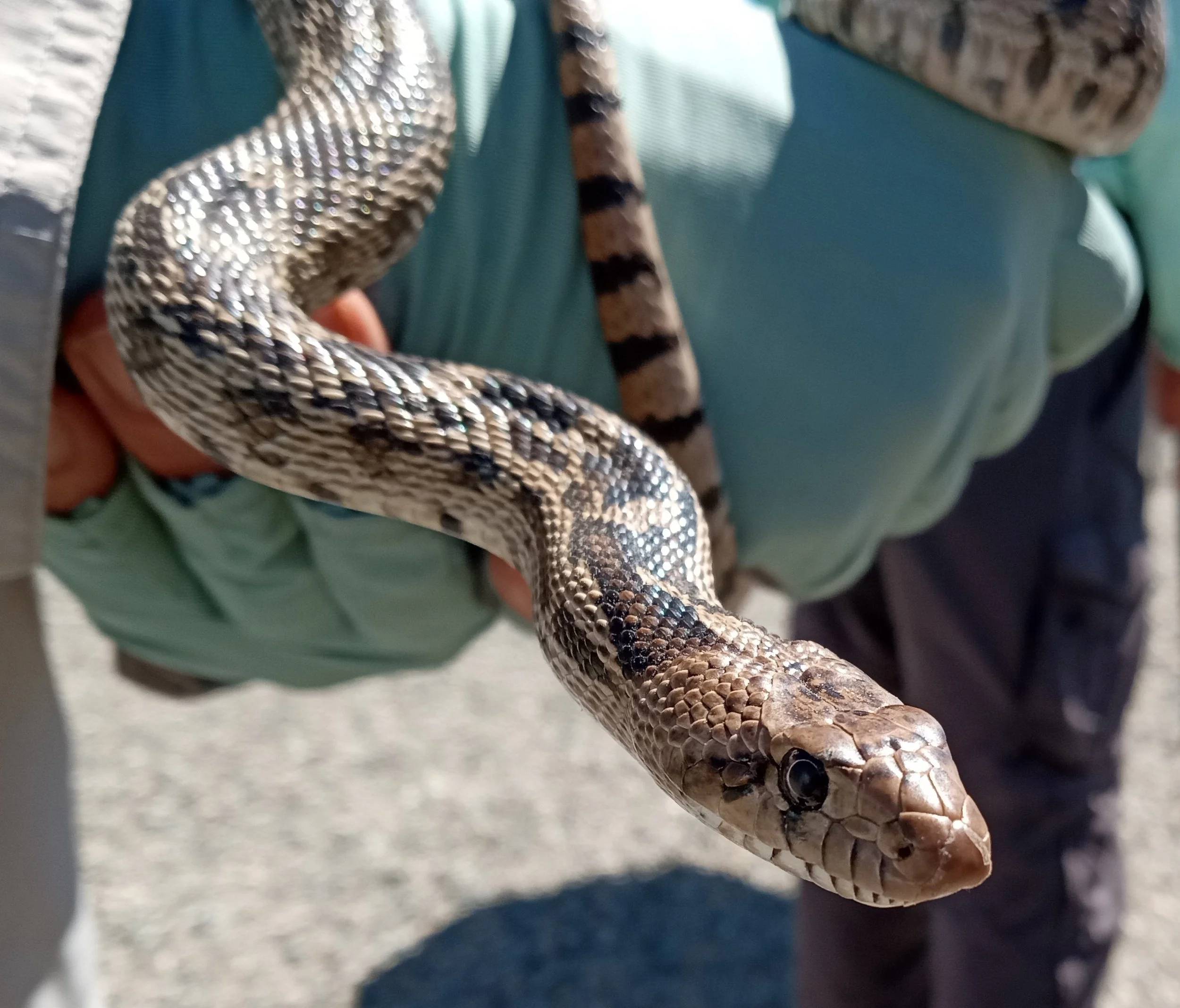
Pacific Gopher Snake (Pituophis catenifer)
Methow Valley, May 12, 2024
Stephen S. Hall’s latest book describing the lives and extraordinary abilities of snakes is that most enjoyable and effective combination of science and storytelling that I hope is reaching a wide audience. An award-winning author, Hall’s earlier books investigated such topics as the immune system, synthesizing human genes, and an examination of how height affects happiness and health in human males. So, it doesn’t seem a stretch to say that Slither, How Nature’s Most Maligned Creatures Illuminate Our World, https://www.hachettebookgroup.com/titles/stephen-s-hall/slither/9781538741351/, is quite a deviation from his previous work. Still, it was perhaps simply a book long in the making. Hall became interested in snakes at a young age, and he begins Slither with a story of his 13-year-old self and an encounter with a ribbon snake. This was a formative episode for him and one that began a lifelong fascination with these reptiles. Hall writes, “Snakes don’t let go of our collective imagination. Of all the creatures on earth, they seem to incite more awe and fear, more earthly fascination and philosophical musing, more veneration and more hatred than any other animal with which humans interact.” His respect and appreciation for these “most maligned” creatures is clear, as is his curiosity about their lives as individuals and as groups of species adapting in a rapidly changing world.
Slither is filled with stories of individual snakes and their personalities, snake researchers and their investigations (some of which I found to have insufficient management application to justify the trauma to the animals), social commentary about sexism in the field of herpetology (loved this quote in the chapter, Snake Guys-“It was as if snake expertise, like an unusual form of snake reproduction itself, was a kind of parthenogenetic process that produced only single-gendered offspring.”), and the many threats facing snakes from outright persecution to the slippery impacts of global climate change.
There is the story of Female 21, a beloved black-tailed rattlesnake who Harry Greene, a well-known herpetologist who wrote Snakes: The Evolution of Mystery in Nature (University of California Press 1997), had a very close and unplanned encounter with one day. Greene had been searching for Female 21 in the leaf litter beneath a juniper tree, but he was having trouble and “getting confusing signals on his radio receiver.” As he is crawling around under the tree and finding nothing, he decides to sit up and think. Now, Greene’s head is among the branches of the juniper and soon he has the sense that there is something very close to his left eye. Female 21 was mere inches from his face, a possibility he might have considered if he’d not been so focused on believing the snake to be in the leaf litter. Not to give too much away, but this story ends well for both.
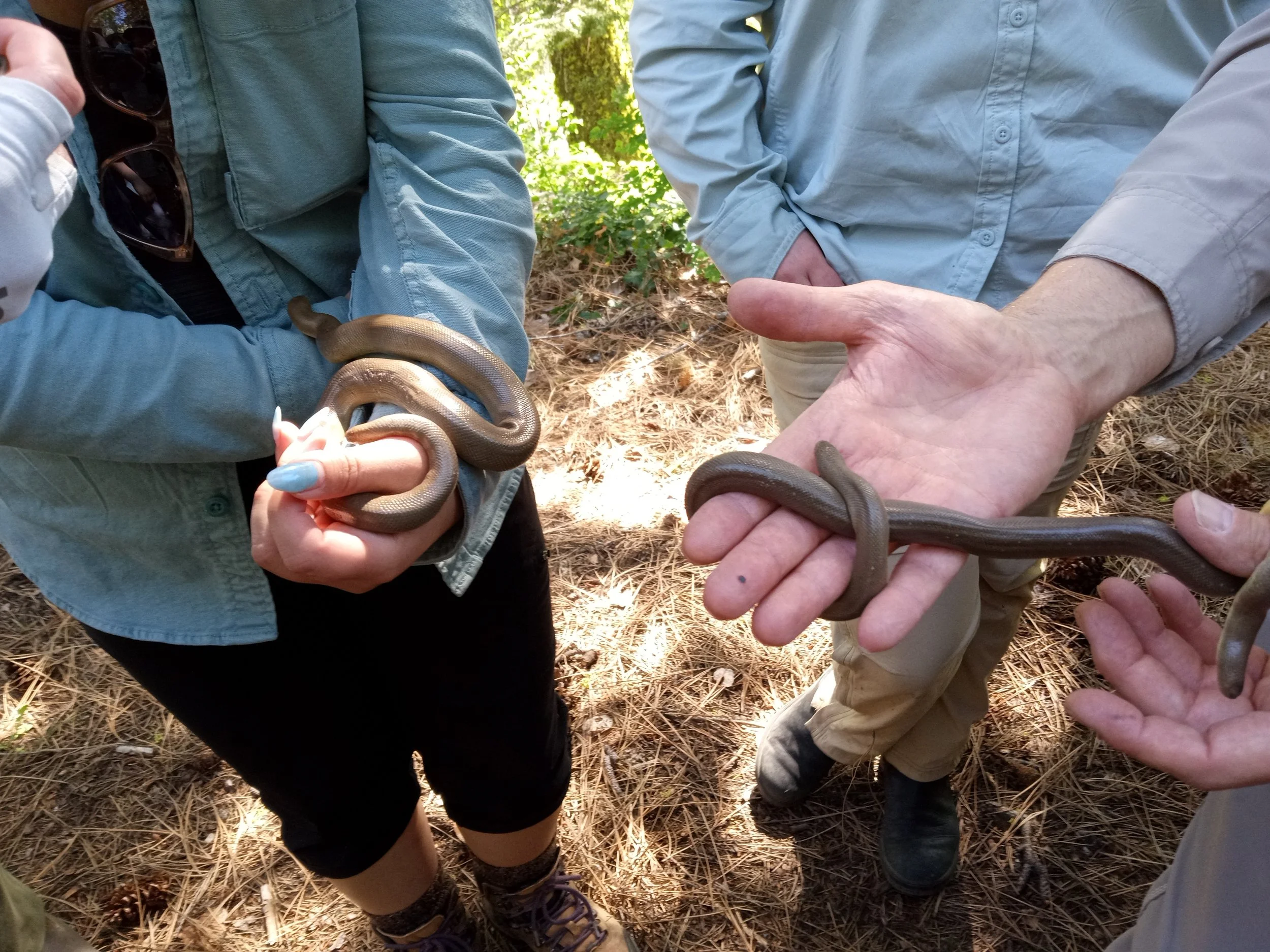
Rubber Boa Snakes (Charina bottae) in the Methow Valley
These two snakes, as was the gopher snake above, were found during the 2024 Snake Search class offered by the North Cascades Institute.
There is plenty about snakebites in Slither as well as the importance of venom-derived drugs to human health. There is also much on the latest research and understanding of snake physiology, including the amazing metabolic changes in pythons when they eat and the interesting brahminy blind snake where all the individuals are female and all offspring are clones of the female.
Additional social commentary that I appreciated came in the chapter, The Python Queen of South Florida, and involved Hall’s reflections on the word, invasive. Few biologists and maybe even few people who make up the general public would dispute the ecological disaster unfolding in Florida due to the presence of Burmese pythons, and Hall summarizes well the impacts from these non-native snakes, as well as the efforts to control them. He also accompanied Donna Kalil, “a legendary snake whisperer and contract python hunter in South Florida,” on some nighttime forays (Kalil describes to Hall the night in 2018 when she was bucked off of an “extremely large python” that she was straddling in the water and grabbing from behind—yikes). Hall writes that “the word invasive often strikes me as a brilliant marketing term, coined by humans to shift attention away from their own stupidity and instead redirect it toward species that had no vote on the matter.”
Slither is well-written and researched and very worthwhile reading.