The Queen Tree
September, 2022
It has been four years since I’ve seen the giant sequoia tree. The world has experienced tremendous events since our last meeting: a global pandemic, the Pacific Northwest “heat dome,” and the Labor Day wildfires of 2020 to name a few. It is now September 2022. The Oregon skies have just opened for a vigorous, short downpour, and I am sitting on a damp bench in front of the tree. In these last years, the tree has had a few branches trimmed and some of the sequoia’s needles are brown, the result of the heat dome, I would guess. Yet, she is as impressive as ever. And as beloved as ever. The Sisters of Queen of Angels Benedictine Monastery in Mt. Angel, Oregon, have trimmed branches carefully for the tree’s health. One terrific branch that remains and sinks to the ground like an arm carrying a heavy load has been propped up by a sturdy block of wood. Other branches are tied together to help support each other. A half of a robin’s eggshell is on the ground next to the tree; woodpecker holes can be seen on parts of her massive body.
In 2018, I published a short piece about this tree at Queen of Angels Monastery in 1859 Oregon’s Magazine. It is always a deep pleasure to visit the monastery and to see the tree. I came here regularly as a child in the 1960s and 1970s as my parents were friends with some of the Sisters and my uncle was a monk at the nearby Mt. Angel Abbey. I am always flooded with memories in Mt. Angel. There is sadness with these memories, as I long for my parents, my uncle, and our friends who are all gone now. I miss the time we spent on the grounds of both monasteries and the simpler place the world at least appeared to be then. But there is also comfort here. The giant sequoia reminds me to remember connection and the power of love even when people are no longer physically present in our lives. The tree, even in our few minutes together, gives so much, and I wish I could do the same. I worry for her and the world we are now living in, with so much stress being poured onto trees from a warming planet. It is hard to sit with such eco-heartbreak, so I stand and walk around the monastery. When I return to the sequoia, I place my hand on her branch-arm and wish her well. How blessed I am to know this magnificent being and her inspiring story.
Click images to view larger.

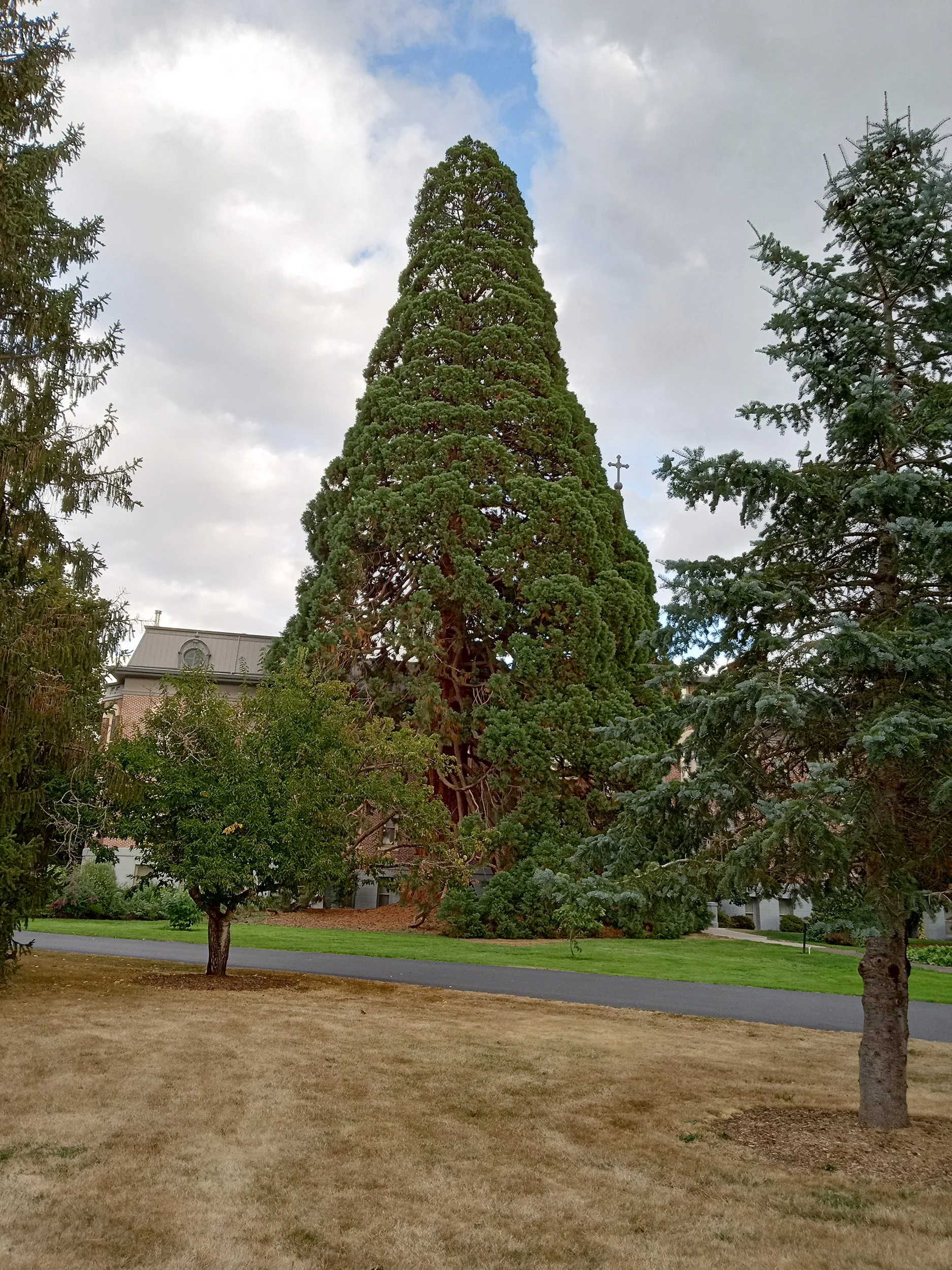

In 1893, just five years after Queen of Angels Benedictine Monastery in Mt. Angel, Oregon, was finished, Sister Protasia Schindler, a young woman in her early twenties, found two conifer seedlings growing nearby adjacent the railroad tracks. Intrigued by the unusual appearance of the trees, she returned to the monastery, got a shovel, and dug them up. With help, Sister Protasia planted them by the building’s entrance. In those years, the monastery had only a well to supply water, so to save on the work of pumping, Sister Protasia kept the water from dishwashing to nourish her new charges. One tree didn’t make it, but the other did. It grew well, and it grew fast, to “enormous proportions,” people said. After a time, the Sisters learned the tree was a giant sequoia, and in just a few decades it stood taller than the four-story monastery building. The tree’s roots, a vast network seeking nutrients and water, grew to the other side of the structure. Sister Protasia lived until 1959, just one month short of her 90th birthday. In her later years, she admitted that if she’d known how big the tree would grow, she wouldn’t have planted it so close to the monastery.
~~~
Sister Protasia’s giant sequoia lives more than 700 miles from the species’ native range on the western slopes of the Sierra Nevada Mountains in California. Queen of Angels Monastery sits on the northeastern edge of Oregon’s fertile Willamette Valley, and the climate here is similar to the Sierra Nevadas, with warm summers and cool, sometimes snowy winters. Giant sequoias, a type of conifer also known as giant redwood or Sierra redwood, push the boundaries of what it means to be a tree. Pulling water straight up for nearly 300 feet against the forces of gravity would seem an impossible task. Supporting multiple tops and branches, some growing several horizontal feet from the main trunk, further defies physical law. Ages measured in millennia, masses measured in thousands of cubic meters, weights measured in tons; these are not descriptions easily grasped by the human mind. The longest-lived known giant sequoia is estimated to be 3,500 years old. A tree that began its life when David was king of the Israelites and the Iron Age had only just started can make the average human life seem terribly insignificant. To some people, this will be disturbing; to others, comforting. Sister Protasia Schindler’s accidental tree, most likely brought as a seed on a load of lumber from California, may still be growing in the year 5,000.
~~~
Long ago, the lowest limbs of the giant sequoia became too heavy to support their individual weights. Consequently, they all dropped back to the ground, and with the steady support of Mother Earth, began anew reaching toward the sun. The largest is thicker around than my thigh. My partner and I take photos by the limb and then shoot the camera up into the dizzying tapestry of branches that extend the height of the tree. We have come to the monastery for a night at the Shalom Prayer Center, the Sisters’ welcoming retreat house where a peaceful environment is offered for solitude, reflection, and spiritual refreshment. After checking in, we immediately were drawn to the giant sequoia, its conical form the largest on the monastery grounds and nearly perfect. At certain angles, the tree appears taller than the building’s spire. While Barbara and I marvel from the ground at the thickly furrowed bark and read the informational sign placed nearby, songbirds move in and out of the upper limbs. These robins and juncos and jays are easily heard but not easily seen. According to monastery history, an owl took up residency in the giant sequoia one year. As owls are wont to do, it began hooting at night from the tree. Sister Gemma, a bird watcher and lover of avian life, decided to play recordings of bird calls from her window to further encourage the owl. Meanwhile Sister Immaculata, less thrilled with the owl’s vocalizations, began throwing walnuts at it. It wasn’t until the next day that the two women learned of the mixed messages they’d been sending the bird.
In the past, the tree supported not only birds but humans as well. Permission was granted in the early years of the monastery to climb the tree on July 4 to view the fireworks. At that time, the Sisters still wore full habits. Though the tight-knit branches offered almost steps to the tree’s top, it still must have been a challenge wearing ten yards of black cloth, a veil, and a headdress. Conversely, the ascent was much easier for two young college students in the late 1960s who had decided to climb the giant sequoia and remove the top for a Christmas tree. Ten feet of branches below the top were cut before someone inside the monastery heard the disturbance and called the police. The top was saved, but all in the community were devastated at the thoughtless damage done to the tree. The sisters consulted an arborist who recommended just letting the tree heal itself, which it has done. A slight indentation is all that’s now visible to mark this event. As homage to the tree, the Sisters created a new logo for Queen of Angels using a drawing of the damaged tree as a symbol of change and struggle, but also of strength and stability.
In 2004, the Heritage Tree Committee of Oregon designated the Benedictine Sisters’ giant sequoia an Oregon Heritage Tree. Criteria for such recognition includes accessibility to the public, historical significance, and tree health. Most importantly, a selected tree, silent though it may seem, must also tell a story. The history of the tree is the history of Queen of Angels: World Wars, the Great Depression, community members arriving and leaving, and the many ups and downs that are intrinsic to any life.
~~~
The Sisters of Queen of Angels follow in the 1,500-year Benedictine tradition of gentle and reverent stewardship of the land, and they believe in cherishing and nurturing all that is touched by the Creator’s hand. This includes the land which provides food, basic sustenance, and a place for prayer and spiritual well-being. In the treatise, “Of All Good Gifts,” written by the American Benedictine Sisters in 1980, there is a Statement on the Nature of Stewardship. This section acknowledges the reality of environmental problems that “are spiraling toward catastrophic consequences.” It also states the community’s firm belief that the land is a gift from a loving God and as such is to be held in sacred trust. Accordingly, the Benedictine Sisters vow to restore and improve the land, respect the habitat of wild creatures, advocate for environmentally sound laws and policies, and retain ownership of their land. The fruits of these tenets are amply visible across grounds that are immaculately tended and which support many species of trees and shrubs. There is an orchard at Queen of Angels, a vegetable garden, and a greenhouse. As we walk around and absorb the peace of the monastery, we meet Sister Maureen, who tells us she is eighty, yet appears no more than sixty-five. It is a hot June evening in the Willamette Valley and Sister Maureen wears a short-sleeved cotton shirt and light slacks (some years ago, the community at Queen of Angels gave up wearing the full monastic habits, a practical and welcome change, we’re told). Sister Maureen has found us admiring the vegetable garden. She nods proudly, but also acknowledges their chronic challenges with hungry deer. I suggest maybe a dog could help.
“Yes, maybe,” she agrees. “We have cats, but they don’t do much about the deer.”
~~~
Sister Protasia Schindler was a painter and a musician. She taught art and music at the Benedictine Academy in Albany, Oregon, and at the Sacred Heart School in Portland. She specialized in oil paintings and her fourteen stations of the cross reside in the monastery chapel, while her scenes of natural history include views of the Willamette River and various wildlife. To be an artist means envisioning what is not yet created, and I wonder if Sister Protasia saw the small seedlings by the railroad track and imagined what they might become. A giant sequoia is not your ordinary tree. It is a grand master of the landscape, a being that is one of the oldest and largest living organisms on earth. As such, a giant sequoia is impressive even when it’s not living in a forest of its peers. Even when it’s standing alone, as the giant sequoia at Queen of Angels is, on tended grounds among a community of oaks, maples, dogwoods, and other trees so unlike itself. And even when, relative to some of its famous brethren, it’s just a baby.