
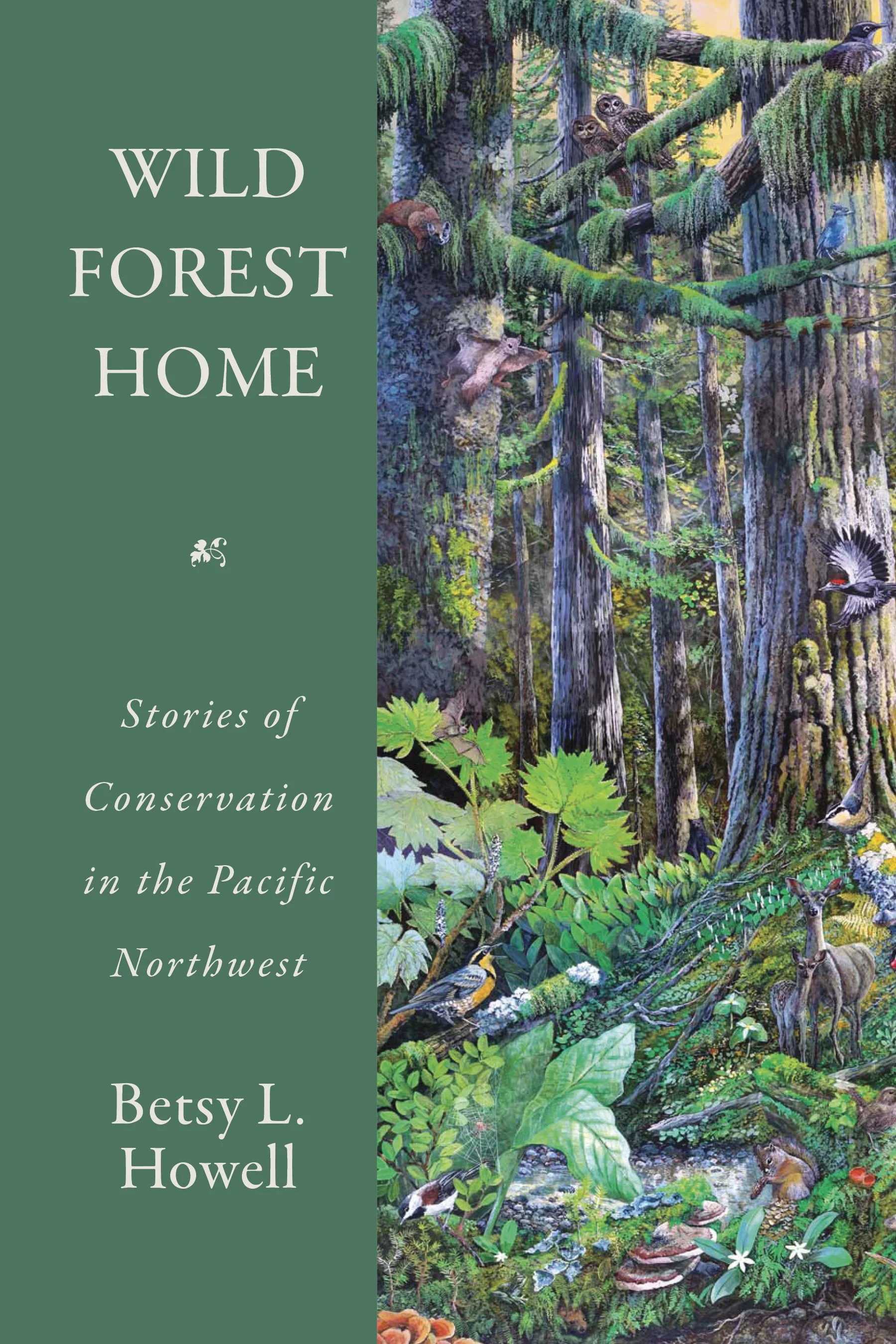
Wild Forest Home
Stories of Conservation in the Pacific Northwest
Growing up in the Pacific Northwest, Betsy L. Howell spent her childhood exploring and thriving in old-growth coniferous forests.
In the summer of 1986, she volunteered in Mt. Hood National Forest, surveying northern spotted owls. That summer position turned into three decades as a wildlife biologist with the U.S. Forest Service during a time of tremendous change within the agency.
The twenty-five essays in Wild Forest Home chronicle Howell’s career and personal experiences studying the wildlife of the Pacific Northwest during the litigious listing of the northern spotted owl and marbled murrelet under the Endangered Species Act and the Clinton administration’s adoption of the seminal 1994 Northwest Forest Plan. Meanwhile, Howell toiled on fire crews, searched for rare species, helped to monitor fishers reintroduced to the Olympic Peninsula, tested amphibians for deadly diseases, became a writer, and mourned the deaths of her parents. This captivating memoir seamlessly blends story and science to reveal a unique portrait of the struggles and joys of one wildlife biologist.
Excerpt from the Introduction
The bed of moss and duff I’m lying on is a foot thick, the tree next to me several centuries old. Looking up, I see the intricate forest canopy, a tapestry of interlocking branches and kaleidoscopic sunlight. In this temperate old-growth stand on the Olympic Peninsula of Washington State, the past is everywhere: A log that’s now melting back into the earth. Ancient trees shortened by coastal winds that snapped them like twigs. The moss bed itself a blanket of time’s decomposition. Hints of the future are here too: A western hemlock seedling the size of a button growing on the log. Knee-high huckleberry bushes. The fruits of fungi no bigger than my thumb. The air and ground are verdant, filled with vibrant bigleaf maples and vine maples, sword fern, deer fern, and licorice fern.
The amount of life here is awe-inspiring. I think, as I often do when I’m in these forests, of a quote by plant ecologist Frank Egler: “Ecosystems may not only be more complex than we think, they may be more complex than we can think” (italics mine). Yet I have worked for many years to understand, or try to understand, the intricate ecology of these forests. As I close my eyes during my lunch break on this uncharacteristically warm, dry afternoon in the Olympic Mountains, I relax into the ringing trills of varied thrushes and the tiny squeaks of chickadees and kinglets. Suddenly, a loud chatter startles me. A Douglas’s tree squirrel has noticed my arrival and determined me an intruder. Though it’s true I’m only a visitor to the forest, I also know I belong here.
***
For more than 30 years, I’ve had the great fortune to spend many of my days in the temperate rainforests of Oregon and Washington. Since 1986, and except for a few years spent in the Peace Corps and also studying writing, I’ve worked as a wildlife biologist for the U.S. Department of Agriculture, Forest Service in the Pacific Northwest. I began in the Mt. Hood National Forest east of Portland, Oregon. Three years later I migrated south to the Siskiyou National Forest (now the Rogue River-Siskiyou) on the southern Oregon Coast. Most recently, since 2004, I’ve worked on the Olympic National Forest in western Washington State. This westside forest is similar to the other two but also unique in its “island-like” location on the Olympic Peninsula, which has saltwater on three sides and urbanization on the fourth.
I stepped into the agency during a time of great transition, just before the northern spotted owl and the marbled murrelet were federally listed under the Endangered Species Act. These two very different birds, one a raptor and one a seabird, are both dependent on the ancient coniferous forests of western North America, the very same forests that have also supported humans since time immemorial. For 10,000 years, Indigenous tribes lived with and utilized the landscape’s forests sustainably. For the last century and half, after the arrival of European settlers, the use has been extractive and commodity-driven. After the owl and murrelet were designated as threatened species—in 1990 and 1992, respectively—lawsuits, uncertainty, anger, and fear consumed the region where the economy and society had depended on harvesting trees for a century.
President Bill Clinton’s 1994 Northwest Forest Plan sought to provide direction for a society in turmoil. This document ushered in sweeping changes in the management of forests within the range of the northern spotted owl. Natural resource management on federal lands began moving from emphasizing products to emphasizing ecosystems. From focusing on single species to assemblages of species. From looking at animals and plants in terms of utility to humans to valuing their function in the environment apart from us. My own career as a biologist reflects this evolution. I began surveying for spotted owls, then moved into working with both owls and murrelets. Soon, I was trying to find small carnivores, including Pacific martens and fishers, as well as amphibians and reptiles. Then came songbirds and mollusks, other raptors and invertebrates. The more species that I learned about, the more the complexity of the forest became clear. The more the connections of the forest ecosystem became illuminated, the more I wanted to learn about everything. This has necessarily meant a career as a generalist rather than a specialist, but it’s a path that has suited me well.
In my early years with the Forest Service, we biologists needed to prove harm to wildlife from management actions in order to mitigate those actions, particularly for those species that were federally listed under the Endangered Species Act. After the adoption of the Northwest Forest Plan and the reduction in timber harvest levels, we, in partnership with our forester colleagues, now needed to show how our activities could benefit wildlife populations. Yet it hasn’t only been changing societal values or management direction that has transformed the landscape in the last 30 years. The dynamic forces of wildfire, the arrival of invasive species, the appearance of wildlife disease, and the many-layered impacts of climate change (including drought, rising ocean temperatures, and catastrophic and sometimes unpredictable weather events) are all tremendous challenges that are happening at once. No wonder Frank Egler doubted our capacity to even be capable of understanding it all. Yet understand it we must, at least as best we can.
Praise for Wild Forest Home
“Howell takes the reader into the fog-wreathed forests of the Pacific Northwest on wildlife surveys to study spotted owls, marbled murrelets, martens, rough-skinned newts, and ensatinas. These field notes from the work of a wildlife biologist are interspersed with timely and moving accounts of working on wildfires and more reflective essays on the craft of writing and the art of stewardship.”
—Thomas Kaye, University of Birmingham, Western American Literature
“Wild Forest Home provides beautiful descriptions and details of the species, landscapes, and socio-political situations that lie beneath wildlife conservation in Pacific Northwest forests. I recommend the book to wildlife professionals, non-biologists who enjoy natural history, or to friends or family who wonder about the day in the life of a wildlife biologist. We all have stories worth sharing, but few authors manage to weave natural history and autobiography with the reflective grace of Howell.”
—Jessica Homyack, Weyerhaeuser, The Journal of Wildlife Management
“[Wild Forest Home] book does an outstanding job explaining ecological concepts and their application to organisms, communities, and systems in Oregon and Washington. As Howell wrote this memoir, she surely had no idea that it would serve as a testament to the value of the [U.S. Forest Service]—and its hardworking dedicated employees—at a time when the agency’s workforce has been cut by 10 percent and threatened with further drastic cuts to its budget, personnel, lands, and mission.”
—Evelyn Brister, Rochester Institute of Technology, H-Net Reviews

“Drawing extensively from her own experiences as a wildlife biologist in Washington and Oregon from 1986 to 2020, Betsy L. Howell explores her professional calling in these 25 personal essays. Her collection melds evolving technology with scientific inquiry and contemporary conservation challenges, particularly loss of old-growth forests.”
—Washington State Magazine
“Essential reading for anyone interested in field-based biological research.”
—Jerry F. Franklin, College of Forest Resources, University of Washington
“A unique account of a wildlife biologist in the Pacific Northwest during a revolution of changes to forestry science and management. I have never read anything like it before.”
—Deanna (Dede) H. Olson, retired, Pacific Northwest Research Station, USDA Forest Service
“This unique and entertaining book provides a vivid portrait of the day-to-day activities of a professional wildlife biologist working for the U.S. Forest Service. It is also a very personal and uplifting memoir in which Howell describes the many ways that her strong spiritual connection to Pacific Northwest forests has helped her overcome various challenges in her personal life.”
—Keith B. Aubry, retired, Pacific Northwest Research Station, USDA Forest Service