
Garden Dispatches
Spiraea Bush
April is one of my favorite months. Enthusiasm and hopefulness infuse this time of year, spring in the northern hemisphere. Some friends have left, for example, the trumpeter swans, while others have returned, including the swallows and turkey vultures. Others, such as the queen bumblebees and frogs, have simply awoken. There is much distressing news in the human world today, but in a garden one can let the mind rest, if only for a while. Thoughts can focus on life and renewal, as well as the impermanence of each moment, a truth that increasingly brings me comfort rather than worry.
But this is a post about dispatches, or “news reports” from the natural world. What is unfolding in our garden and beyond?
The American goldfinches never left us this winter. My understanding is that this is only the second time in perhaps the last 30 years that their staying has been observed in this area. Last October was quite warm, so perhaps the temperature cue to leave was never strong enough. Very likely too, with plenty of food from bird feeders, the goldfinches wondered, “Why travel?” For us, it has been delightful to have them during the cold, gray months of a Pacific Northwest winter. Even in their winter plumage, a duller mustard color (which is now rapidly, for the males, changing to bright yellow), they have still been bright flashes of color.
Trumpeter Swans, Olympic Peninsula
The golden-crowned sparrows are still here and they, too, are now adopting their breeding plumage, including the striking gold crest and black eye stripe. The last couple of years I have noted the golden-crowns gone around mid-May as they head north to their nesting grounds. Last spring, I also observed them eating most of our cherry blossoms, which resulted in no cherries. This year, I will try to discourage this.
Standing in the garden to observe and appreciate all the new growth, I am privileged to see that which requires stillness. One afternoon, as I worked quietly around our suet feeder, the friendly flock of bushtits arrived. These birds are regular visitors, but for the first time they were only a couple of feet from me. For the first time, I could see the distinctive eye ring worn by the females, a contrast to the solid, dark eyes of the males. I stood there some minutes, delighted that my presence was accepted by the bushtits.
Several days later, I stood in the same spot, doing nothing this time but admiring the star magnolia flowers. Again, I was rewarded. Out of nowhere, a Cooper’s hawk swooped in and landed in our apple tree, just eight feet from me. A female, she either didn’t notice me (seems unlikely), or, because I was still, didn’t much care that I was there. One of three species of “bird hawks” in our area, the Cooper’s is the middle in size between the smaller sharp-shinned hawk and larger goshawk. A beautiful creature, with striking red eyes and a dappled red/orange breast, the hawk looked around very alert for one of the songbirds, all of whom had scattered. Too soon, with no available prey, she was off again. And a few seconds after her departure, a robin, who had been hiding under a viburnum bush, flapped away with a few calls of relief.
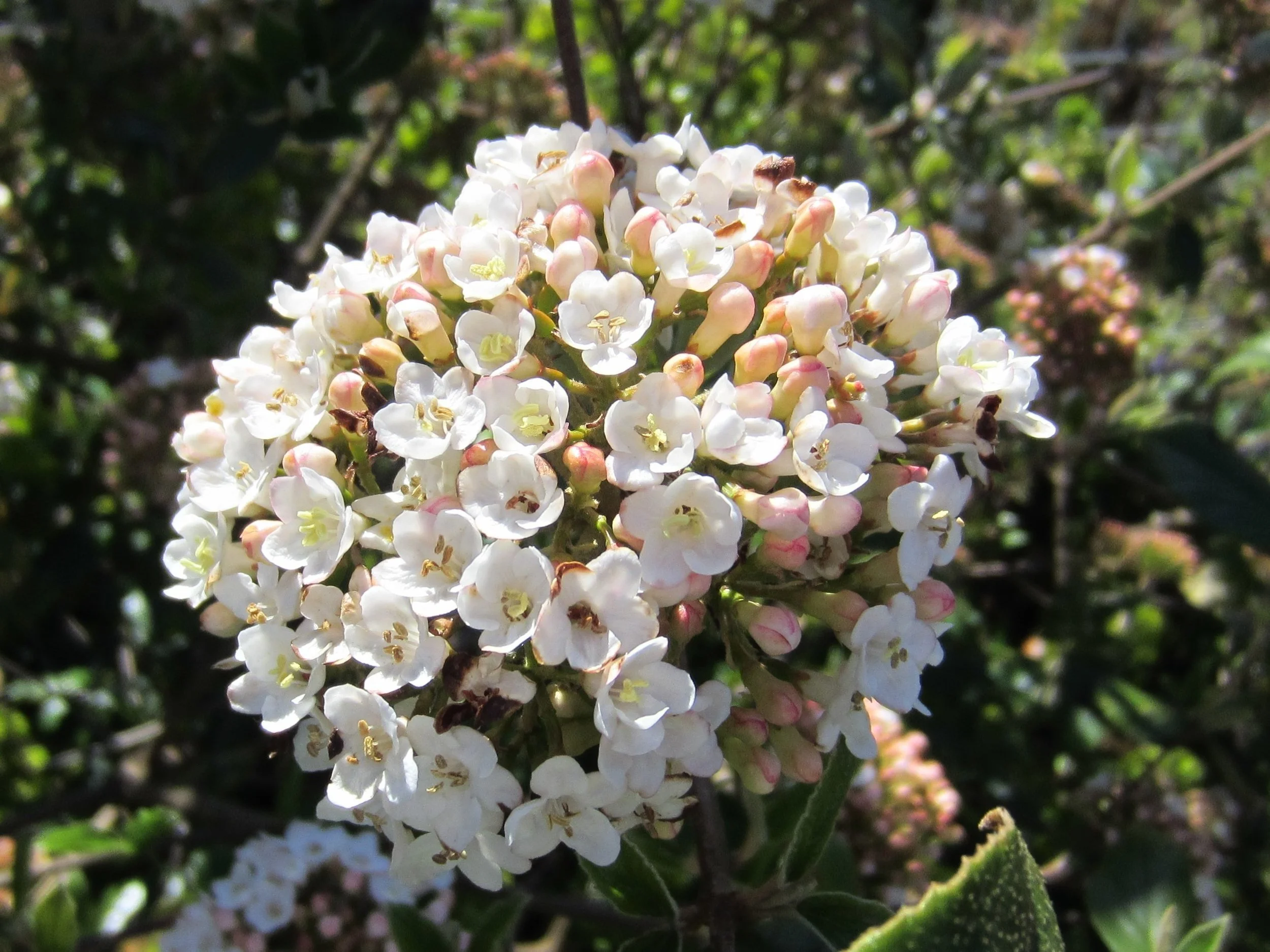
Viburnum flower
Reporting from our neighborhood, in the nearby wetland the Pacific tree frogs are in full chorus and egg masses have been visible since the spring equinox (at least that’s when I first noticed them). A great blue heron is often at the wetland, still as a statue mostly, but also moving ever so slowly and methodically in its hunt for frogs.
Even farther afield, to the south and west of our little town, I have seen the first two garter snakes of the season. One moved off as I approached on the trail, but it didn’t go far. As I remained still, the snake reappeared from beneath last year’s fallen leaves. She, or he, then began to move around slowly, exploring the area in a quiet way. It’s so rare that I actually get to watch a snake just going about its business that this was a very special moment.
Recently, I’ve been reading about and listening to podcasts on the topic of “deep listening.” Thich Nhat Hanh writes about the power of listening in his book, Zen and the Art of Saving the Planet: “To listen is first of all to be full present and not distracted.” Deep listening isn’t only about being able to hear others; it’s also about hearing ourselves, as well as the earth and all her inhabitants. To be still enough to hear communications from the other species, the bushtits, the Cooper’s hawk, and the garter snake, is not only a pleasant experience. In these times, it is also crucial to our survival.