
Tree People
Queets River Trail, Olympic National Park, August 2023
I am thinking a lot about trees these days. I live in a part of the world where centuries-old Douglas fir, western hemlock, western red cedar, and Sitka spruce trees support all manner of life, from microscopic organisms to majestic bald eagles. Around my home, such ancients vanished in the last century, victims of European Americans and a growing society that saw the trees as only commodities. However, in the nearby national park and national forest, they continue to grow. Last week, I did a backpack trip with friends to a part of the Olympic Peninsula that has nine- and ten-foot diameter trees. These remarkable beings are staggering to behold, from the base of each tree, where we humans are ant-like in comparison, on up into the tapestry of branches and kaleidoscopic light shining through.
Here, in western Washington, trees are everywhere, young ones, older ones, deciduous and evergreen, non-native and native. They are part of our daily lives, an intricate world unto themselves, and yet they can be easy to forget about until something happens, such as one falling into the road or on a home after a storm. They “pop” too when they’re full of blossoms or cones, or when they change colors in the fall. Exceptionally large or old ones also garner notice with arrows on a map pointing to, for example, “World’s Largest Spruce.” Trees dying also grab our attention as do whole communities of trees vanishing during wildfires.
I remember certain individuals I’ve known in my life. There is the giant sequoia at Queen of Angels Benedictine Monastery in Oregon, a tree I first met as a child when we would visit family there then later came to know as a middle-aged person (and when the tree was relatively young at only 122 years old!). There is also an old oak tree that grew behind my childhood home and that I remember well (upon looking at Google maps, I see it is still there). Another second-growth fir in the 1970s behind our cul-de-sac was the tree where a friend of mine got stuck after climbing too high (her father had to rescue her by climbing up himself).
Click images to view larger.

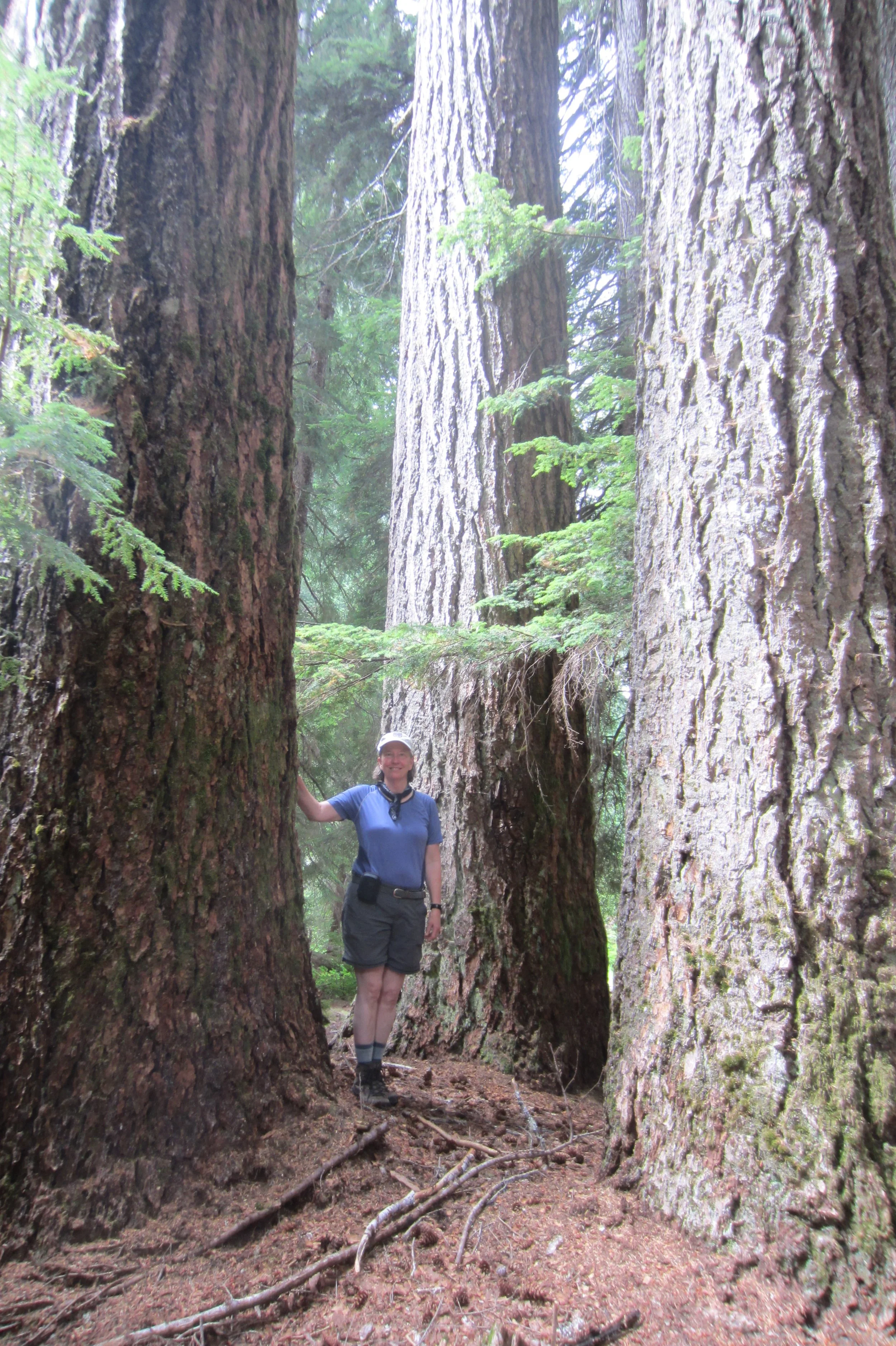

L to R. Sitka spruce, Queets River, 2023; Douglas fir at Diamond Meadows, Dosewallips River, 2022; Sitka spruce, Queets River, 2023.
These days, I drive around the Olympic Peninsula and notice trees that look stressed. Some have died and others have brown needles. Widespread drought in 2015 across Washington State, with a winter of 2014/2015 that saw very little snow in the mountains, has been affecting trees ever since. The tremendous heat dome of late June 2021 didn’t help (I am especially noticing cedars beginning to die in certain places) and the summer of 2023 has been very dry on the Peninsula. It shows as the trees struggle with the twin challenges of a lack of moisture as well as higher than average temperatures. Many of these trees are in plantations or older second-growth stands, landscapes far different from the complex forests of old.
In Suzanne Simard’s recent bestseller, Finding the Mother Tree, Discovering the Wisdom of the Forest, she writes about her research investigating the underground connections between trees that facilitate the exchange of nutrients and carbon, and the unequivocal way that trees, including different species, support each other. After she was able to prove these connections scientifically, Simard went to the forestry management community to try to persuade policy makers to rethink their removal of what they considered trash trees (e. g. birch and alder) based on the notion that cooperation, rather than competition, is a driver in forest health. Needless to say, this was a hard sell. As I continued reading her descriptions of the scientific proof piling up, which, incidentally, Simard acknowledges as understanding Indigenous people have long had, and the resistance to changing management practices, I wondered why this is. Why don’t the predominant management makers, that is, non-Indigenous people, default to cooperation being a greater force than competition? Is it because many forestry practices today stem from those of us who colonized these lands and outcompeted those who were already here? And we’re used to that kind of relationship, rather than one of cooperation and reciprocity?
This is a very large question with many strands of answers, I think, but the important point here is that Simard’s work has demonstrated the individuality of trees, their connection to and care for each other, and the complex world they are a part of and support. Her book is an important contribution to understanding these aspects of forest ecology. As she journeys through her research, uncovering profound truths about the nature of these connections, she also writes about her own life and how one mirrors the other. Reading a few online reviews of Finding the Mother Tree, some people wanted more science and less of Simard’s life, but I think she ably illustrates various points about trees caring for each other, recognizing each other, supporting, nurturing, and protecting each other, and that all of these are traits we humans aspire to as well. At the end of the book, she captures the essence of what she’s learned when she describes “complexity science,” which involves accepting that both cooperation and competition occur in a forest, and can be embraced to transform “forestry practices into what is adaptive and holistic and away from what has been overly authoritarian and simplistic.”
As we hiked along the Queets River in the Olympics last week and passed by one giant Sitka spruce and Douglas fir tree after another, I thought of all that was going on underneath the great mother trees. It was a warm week though not as warm as some we’ve had recently. I felt so grateful for the shade provided by the forest, and for the many organisms that work together to make this world possible. We took photos by the big conifers and also admired the maples with their great mossy sleeves billowing downward like gowns worn by matriarchs.
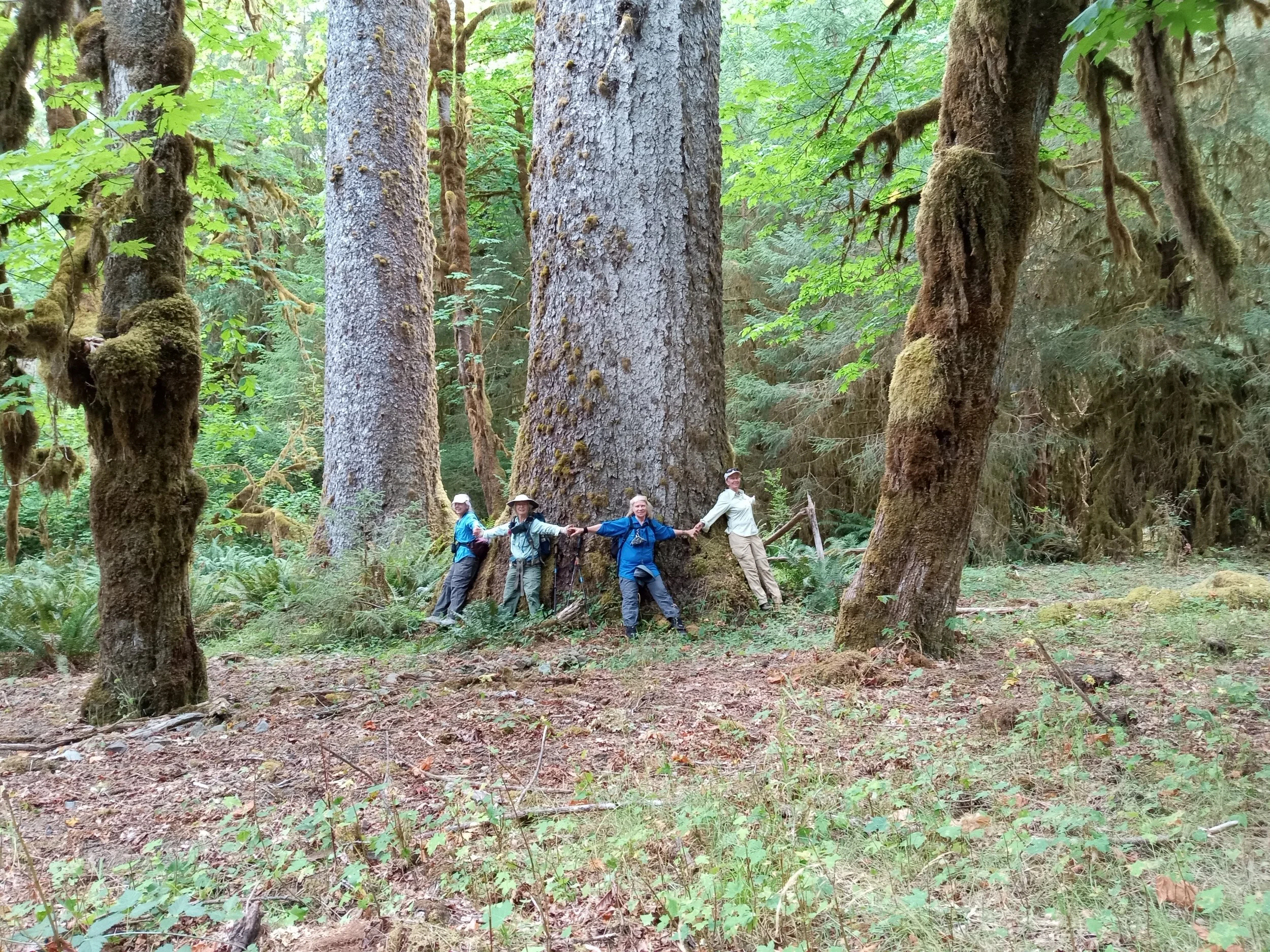
Sitka spruce and admirers, Queets River, August 2023