
Mayne Island: Colors and Connections
Georgeson Island, as seen from Campbell Point on Mayne Island
In Howard Hansen’s wonderful book, Twilight on the Thunderbird, A Memoir of Quileute Indian Life (VertVolta Press 2013), he writes of the Pacific Northwest’s own unique color palette:
It was an almost black and white world, the world of Coast. Except for Sunsets there was little of vivid color in which to immerse ourselves[.] Mist, interspersed with the brown-grey-green of Spruce, Hemlock, Fir, together with the grey of Ocean, and the whiteness of Combers coming to rest after perhaps six-thousand miles of having been waves, were the major colors of our Lives.
Sunrises and sunsets provided color, and “Rainbow gave the color spectrum, when we could see it…rare and impressive.” During certain times of the year, shrubs and flowers also provided color:
In its season, in their seasons, Fox-glove lent color beauty, as did the subtle scarlet of ‘Bull Thistle’; ‘Canada thistle’. Black berry; Salmon berry; rare-to-be-seen wild Strawberry flowerings gave subdued color to which we were audience.
As I stood on the shore of Mayne Island, one of the southern Gulf Islands in British Columbia, Canada, I thought of these words, of the respect Hansen shows the color bearers, and of the world of subtle shades that enveloped the Quileute people since time immemorial. For me, on this day in late September 2025, the view included black offshore rocks. A slate blue Heron wading at the water’s edge. Steely gray waters blending into pearl skies. Gulls and River Otters and Cormorants provided points of movement, as did the Heron sporadically; a drop of her long neck, a lightning-fast jab of the thick bill, and a wriggling, silver Fish was caught, then a few minutes later, a second. Meanwhile, Oystercatchers, with their long, red bills, offered a slice of the rainbow. Hansen’s book, which I had brought to read during our time on the island, is abundant with poignant descriptions of a life and a world that was vanishing for Quileute People. His words gave me yet new ways of seeing and appreciating these coastal environs, landscapes I have lived in and loved all my life. They also are providing me with inspiration at a crucial time.
This has been a challenging year. We went to Mayne Island for a few autumn days of rest and renewal. And to celebrate my 60th birthday. Filled with familiar friends, such as Salal, Swordfern, Douglas fir, Pacific wren (“cho-cho” in the Quileute language), and Banana slug, our walks exploring the island were comforting as well as different. The island’s Black-tailed Deer appeared much darker than our Olympic Peninsula Deer, and were far more wary compared to the tame, town browsers we know around our home. The Red Squirrel is just as plucky and talkative as our Douglas’s squirrel, though with a raspier voice, at least to my ears. As we drove around the 8.2 square mile island, the grays and greens were broken up by autumn’s medley of colors, as well as the red bark of the Madrone trees. To a one, every Western Red Cedar tree I saw exhibited the stress of a warming climate, with brown dead and dying branchlets.
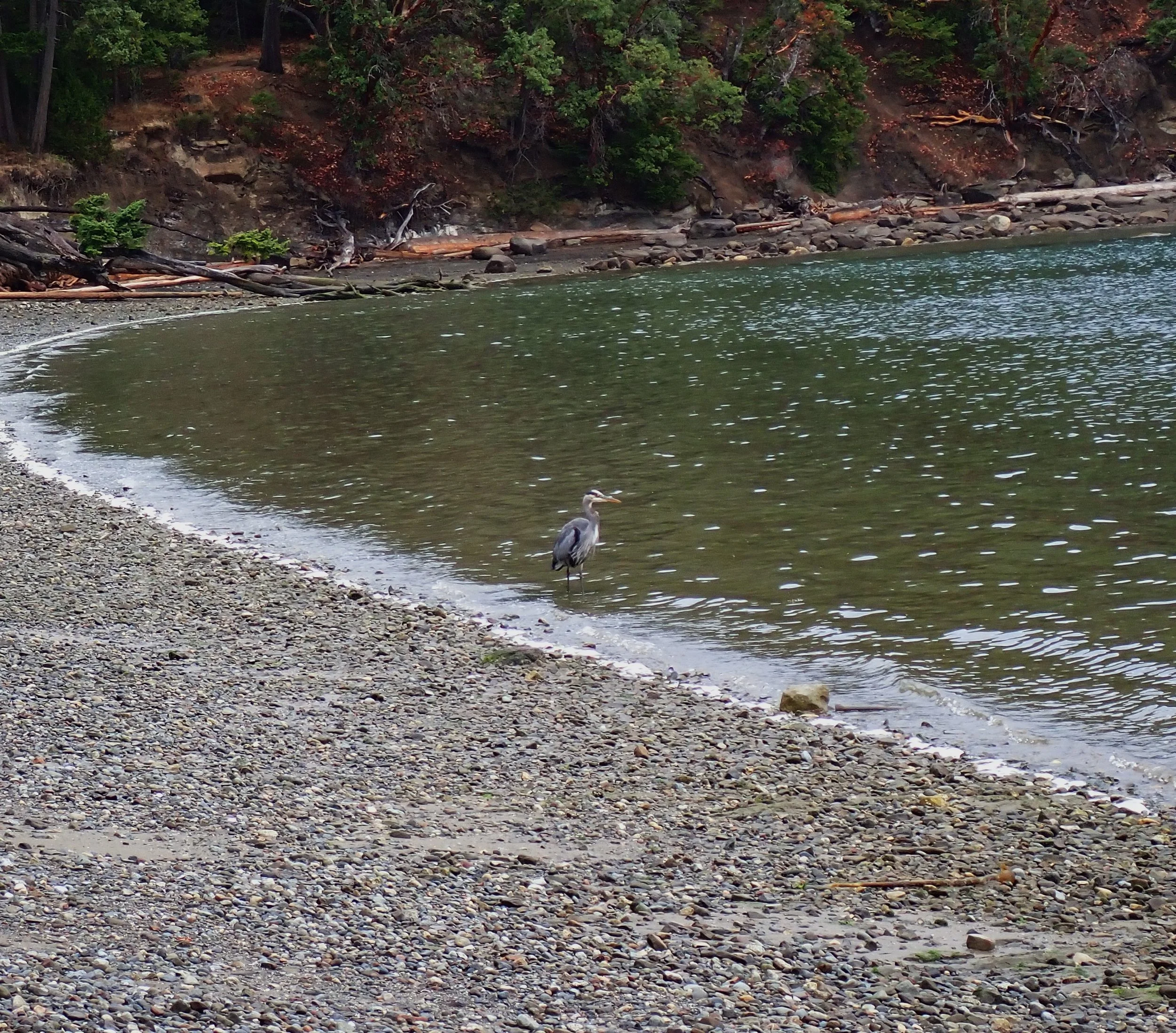
Great Blue Heron
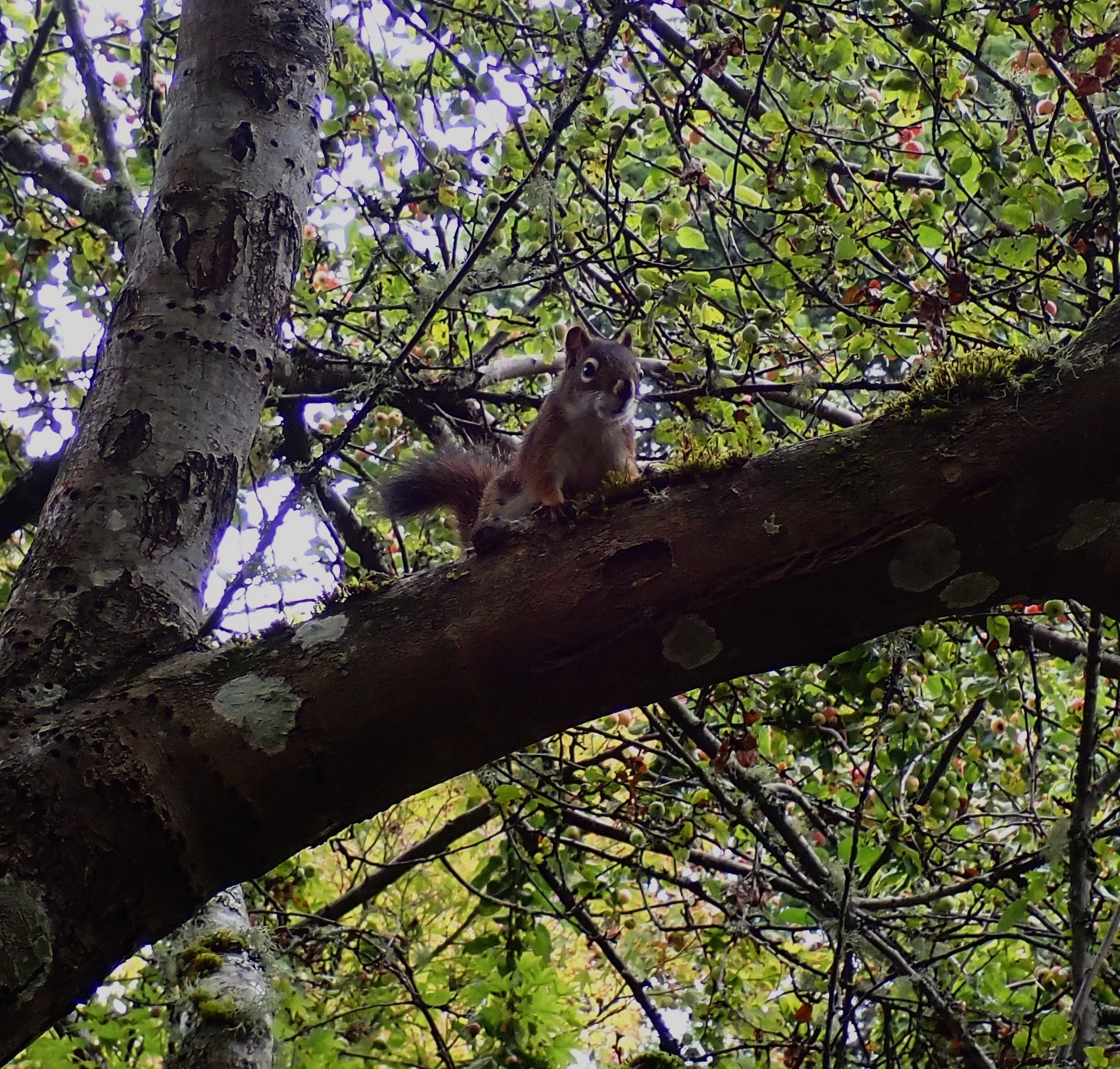
Red Squirrel in the Japanese Garden, Mayne Island
During our explorations, it crossed my mind that Mayne Island might not have Barred Owls, but this was a ridiculous notion, born of hope rather than long experience with the species. On our second day, we found one individual sitting on a wooden fence; later, I heard one calling at Mount Parke Regional Park. Barred Owls are stunning animals, mysterious in their owl-ness but also mirrors for us humans with their intelligence and faces that resemble our own. Barred Owls, however, are also causing great strain to Pacific Northwest ecosystems where they are not native. Many nights at home, I hear them calling around our house; I had hoped to not see them here.
In Howard Hansen’s simply titled chapter, “Slug,” he describes his experience as a young boy learning from an elder about the humanity of this small invertebrate. At first, small Howard doesn’t believe what the elder, Old Man, is telling him, that Slug has a right to live, just as he himself does. Yet, by the end of the lesson, he gets it. Hansen writes, “This day brought a deep, a deep understanding. I knew of a sudden what Po-oke [Quileute People] meant: All Living things are People of one form or another.” Indeed, throughout his book, there are Garter Snake People, Frog People, Shark People, Seal People, and Owl People. I believe this too. Though I am still very concerned about what Barred Owl People are doing to Northwest forests.
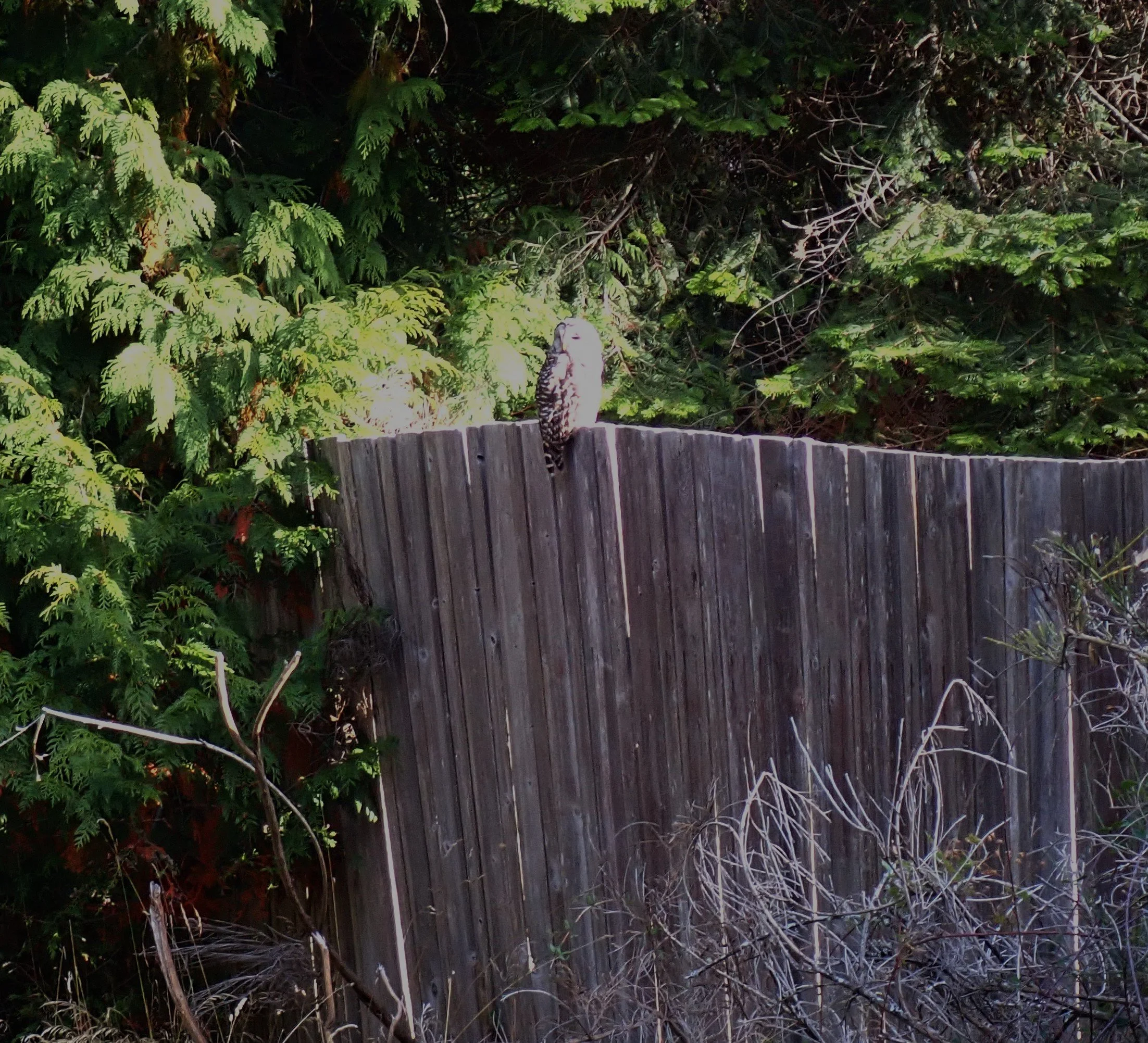
Barred Owl on fence
~~~
The highest point on Mayne Island is along the Halliday Ridge Trail in Mount Parke Regional Park. There, the views sweep wide to the south, encompassing the outlines of Saturna and Pender Islands. Ravens, like shadows, flapped past me, while turkey vultures, whom I thought would have begun their travels south already, soared, ever watchful and at home in the skies.
Coming down from the top along Old Gulch Trail, I encountered a wounded Banana Slug, victim of a careless human or canine foot. As the Slug, a solid forest green color, still appeared alive, I moved it off the trail for recovery beneath a patch of Salal. Another 50 feet on, I encountered a second Slug, similar in color but also festooned with unique black markings and a single dot on its mantle. This Slug, appearing quite well and just beginning the journey across a wider section of trail, moved with singular intention toward its destination: the other side. Feeling this to be a rightful, but hazardous, undertaking for Slug, I felt I had two choices: pick up and move this forest friend out of harm’s way, or stand guard. I chose the latter. Twenty minutes later, I was still standing there, and Slug was nearly to safety. A large group of people passed during this time. They barely noticed me, and certainly not the small creature on the ground. This Slug was now off the path, so I returned to check on the first. The wounded friend had moved some, and I felt hopeful.
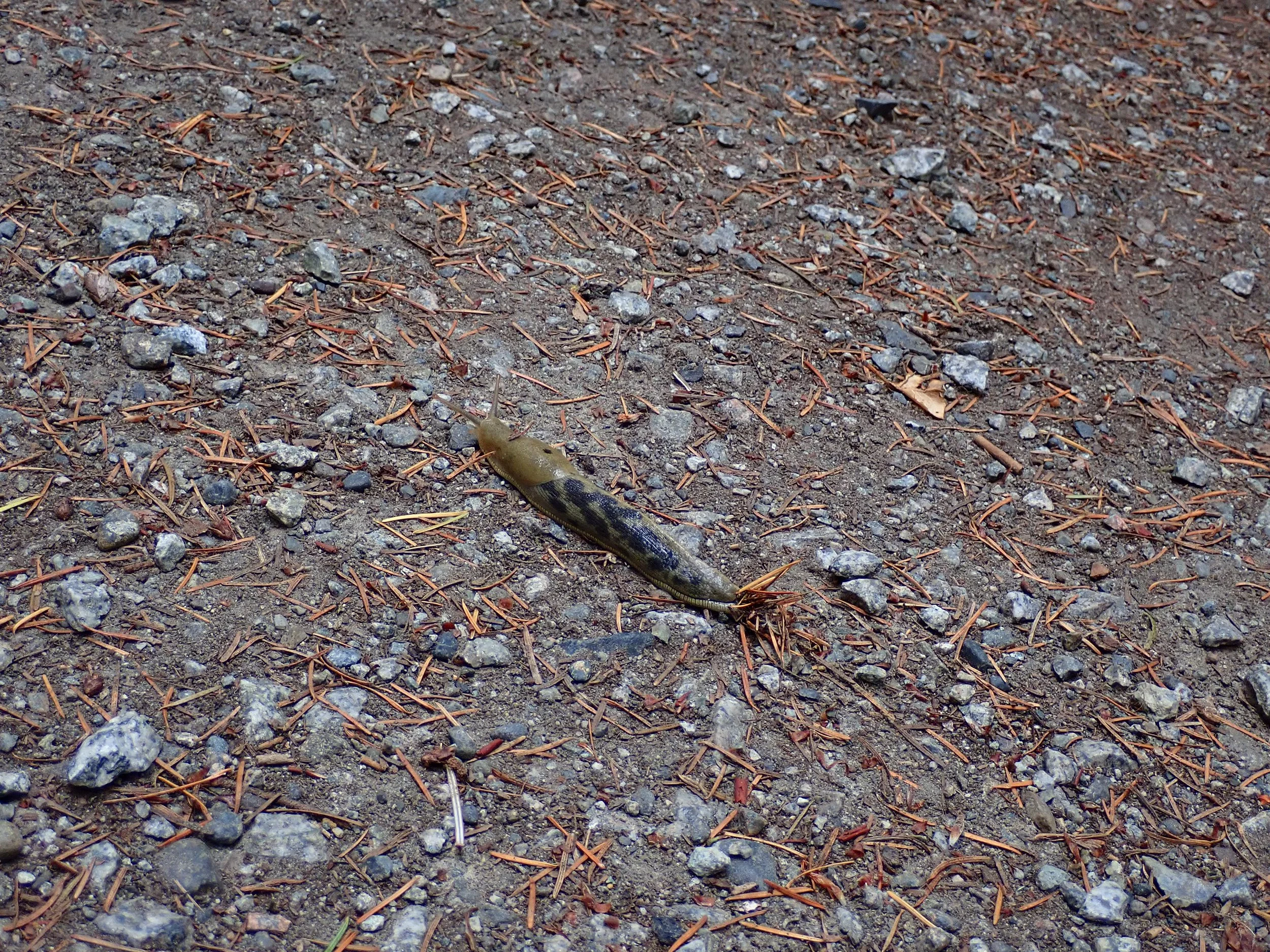
Banana Slug in transit
~~~
The connections that bind us all are both strong and utterly frail. They can snap permanently with a hard look, a harsh word, or an ill-placed step. They can also strengthen through tragedy, form around common cause, shine through the darkest of days. It never ceases to amaze me that so many human people don’t see the foundational truth of dependence and interconnection. Many do, of course, but right now it is particularly obvious that many do not. At their peril, and the rest of ours as well. I am grateful for those who see clearly and strive on behalf of the community. I am grateful for our time on Mayne Island and for Howard Hansen’s book, a gem I just happened to find in a bookstore I rarely visit. I appreciate him sharing his experiences of the world of connection that he learned about and lived and then described. Of the nuances of Pacific Northwest colors, and the life in all things and in all circumstances, including the tremendous pile-ups of ancient logs that landed on Northwest shores after storms:
Who knew those days, as did I, will recall the Life the drift logs sheltered. Thousands of Chipmunks and Ground-squirrels and Snakes. Strange little ponds held tiny Frog people. Large populations of Animals lived among the logs. And so many types of Bird People, vulnerably unafraid, flitting and eating and flying from log to log, nests nearby and protected. Garter-snake People ranged forth and back at ground level, seeking Slug and Frog and Mice and myriad Insects on which they gorged. I caught and lifted a beautiful Garter Snake one day and it vomited a large Slug into my hand. “Eat this, not me!” it said. If Mice eat grain and Snake eats Mice, and Slug, Insects, to stay alive, then Snake is good partner for mankind I decided.
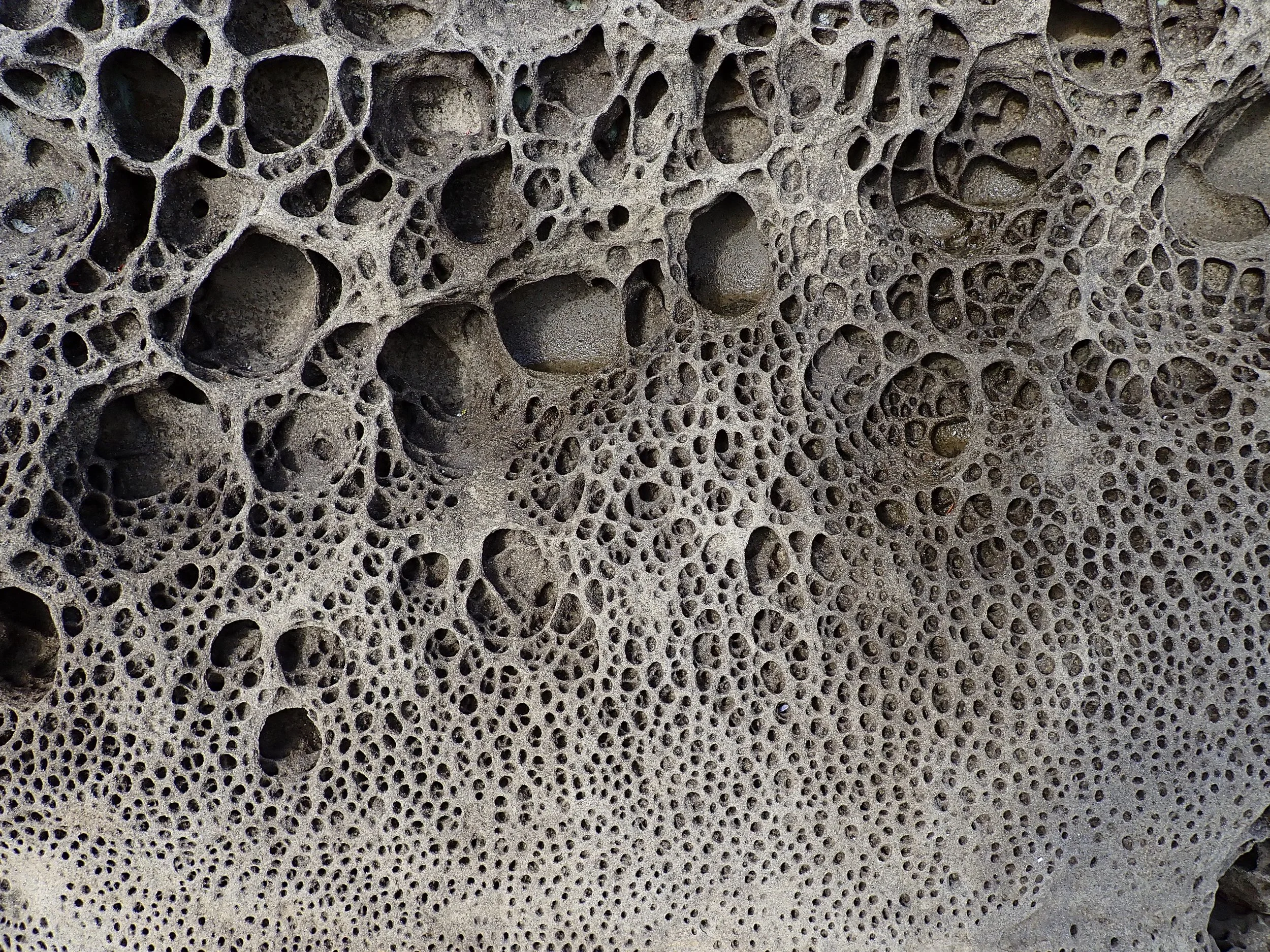
Designs in the rock at Campbell Point, Mayne Island