Bat Medicine
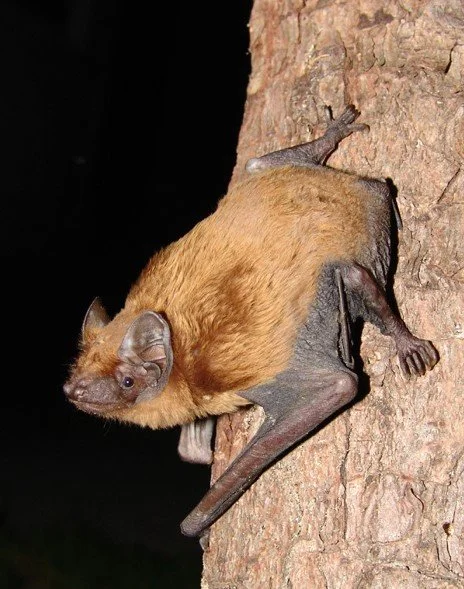
Common Noctule (Nyctalus noctula), by Markus Nolf, Photo taken in Rum, Austria
There is a painful scene in Linda Hogan’s 1990 novel, Mean Spirit, when Belle Graycloud, an Osage woman and grandmother, encounters a truckload of 317 dead golden eagles. The sacred birds have been killed by white hunters for taxidermy shops. She is frozen at the spot and the horror before her:
What met her eyes was a truck filled with eagle carcasses. They were golden brown birds, with the blue-white membranes of death closed over their eyes. For what seemed like a long time, Belle stood rooted to the spot. Her marrow went cold. She stared at the dead, sacred eagles. They looked like a tribe of small, gone people, murdered and taken away in the back of a truck. The hunters were busy beside the truck, counting the eagles.
Belle then runs toward the men, shouting and kicking at them, breaking a window of the truck with her bare hand. Undaunted by the blood or pain, she continues her attack. The men finally subdue Belle and take her to the jail where her husband Moses comes to get her. When Belle tells Moses and their friend Michael Horse, a water diviner and seer, about the eagles, they are “livid with rage and with fear.” The three of them drive to where the hunters are packing the eagles in dry ice, the smoke of which “[erases] the hunter[s’] faces.”
Later, Moses Graycloud and Michael Horse write letters to President Warren Harding. Moses dictates while Michael writes:
…A group of hunters came from the east and by their count 317 eagles were taken from our skies. The eagles are our brothers. Their loss hurts us. …We do not have a desire to see our fellow creatures gone from the world.
Mean Spirit, nominated for a Pulitzer Prize in 1991, was Hogan’s first novel and it recounts the murders of members of the Osage Tribe during the Oklahoma oil boom of the 1920s (also the subject of David Grann’s 2017 book Killers of the Flower Moon). In a 1994 paper in Studies in American Indian Literature on the “Caretaking and the Work of the Text in Linda Hogan’s Mean Spirit,” Anna Carew Miller quotes Hogan from a 1990 interview: “I consider caretaking the basic work of living on earth. … I see a direct relation between how we care for animal-people and plants and insects and land and water, and how we care for each other, and for ourselves. Part of our work here is to care for life.”
I have been thinking of Mean Spirit recently and Moses Graycloud’s words about losing their brothers, the eagles; words from another character are similar when he tells people that the snake is also their sister. When we think of other species this way, it makes our relationships with them, and also what we’ll do for them, vastly different compared to having views of indifference or even antagonism toward other beings. An article in the January/February issue of The Wildlife Professional, the magazine of The Wildlife Society, called “Wildlife during Wartime” by Joshua Rapp Learn, a science writer for the magazine, describes the efforts of biologists in Ukraine to continue their conservation work during the Russian destruction of cities and landscapes which has been going on now for almost two years. The article focuses on the rescue work of the Ukrainian Bat Rehabilitation Center (UBRC), https://batsukraine.org/en/, and the Ukrainian Herpetological Society. Wildlife conservation is a challenge even under the best of conditions, never mind amid the disruption and destruction caused by war.
In 2012, three biologists, Kseniia Kravchenko, Anton Vlaschenko, and Alona Prylutska, co-founded the UBRC to survey bats in Kharkiv, which had begun to winter inside people’s homes instead of migrating to the Balkans (possibly due to a warming climate). The bats’ presence wasn’t popular with many people, and so the surveys also became rescue missions at times. Having this knowledge prior to Russia’s invasion of Ukraine in February 2022 became invaluable in terms of knowing the buildings where the bats roosted. In spite of the immense challenges, including nearly half of the bat buildings in Kharkiv being partially or fully destroyed, the team continues to rescue and rehabilitate as many bats as they can. Learn’s article provides this quote from Kseniia Kravchenko, “It’s amazing how people can adjust to live with anything, even if the city is getting bombed. The UBRC continues to collect bats and monitor what’s going on.”
While the article in The Wildlife Professional is only open to members of The Wildlife Society, the UBRC team has also written up their findings in the ScienceDaily article, “The war-damaged urban environment in Kharkiv is fatal for bats,” https://www.sciencedaily.com/releases/2023/08/230808110856.htm#. In Kharkiv, one of the cities where the fighting has been most intense, it’s estimated that 7,000 bats have been killed by shelling. Additionally, these destroyed structures have become traps for bats as they enter them but then can’t get out. The Common Noctule (Nyctalus noctule) has been one species of bat particularly affected. Of 2,836 Common Noctules discovered trapped inside buildings, about 30 percent were already dead when found.
The UBRC’s website also has some wonderful, short videos of their work and the center, as well as information describing the installation of bat boxes, a citizen science project where people can report observations of bat colonies, and the construction of a “bat collider” (basically a circular bat aviary where bats can practice flying before being released). The post on the bat collider is dated February 2020, and there is also an update in April 2023 showing the restoration of the collider after Russian shells had damaged it. By December 2022, the UBRC had processed more than 25,500 rescued bats and had also reached many people through vigorous education campaigns and the annual event “Bat Release Fest” in Kharkiv, which began in 2013. And despite suffering through a year and a half of war, UBRC and other organizations throughout Ukraine celebrated International Bat Night in September 2023. They write that the event’s “objectives include spreading true information about bats, informing the public about the importance of peaceful coexistence with bats in urban environments, and improving Ukraine’s international image in the field of nature conservation.” There is a map showing all the cities in Ukraine that participated in International Bat Night.
**
One truth that keeps me centered as I gaze around at the tremendous suffering in the world and feel a cold fear in the middle of the night regarding the fate of so many innocents and indeed, the planet itself, is hearing about people who keep getting up every single morning and doing the next right thing. The people working for bats, as well as other wildlife, in Ukraine are heroes. They are doing conservation work under such difficult conditions, but they keep on, doing what they know to be right, for other people and other species, of whom I’d hazard to say they consider their brothers and sisters and just as deserving of life as anybody. Their work has been very inspiring to me as I’ve learned more in recent weeks.
Along with eagles figuring prominently in Mean Spirit, bats too are a part of this gripping story. As the persecution of the Osage people continues, Belle Graycloud ponders “bat medicine” and drawing help, as she puts it, from as many places as she can. Though Belle has arrived too late to do anything for the eagles she encounters in the truck, she soon finds herself witness to a group of white men madly shooting up bats in a place called Sorrow Cave because they believe the animals to be carrying rabies. This time Belle can do something; she calms herself and dispenses with anger for she knows she mustn’t have strong emotions going into this situation. Then she moves into the cave’s entrance and takes out her pistol and points it at the men. Though some bats are dead or dying, many are not. Belle
remained there protecting the double world of bats with their whistling songs and their lives in the cool and deep darkness, the bats who were husbands to trees, the beautiful creatures who were hated by those who lived in what they called the light.
Towards the very end of the book, Belle’s friend Michael Horse “felt as though the bat medicine had wakened.”