
Books in Waiting
“When the Day of Judgment dawns and people, great and small, come marching in to receive their heavenly rewards, the Almighty will gaze upon the mere bookworms and say to Peter, “Look, these need no reward. We have nothing to give them. They have loved reading.”
―Virginia Woolf
There’s nothing like the cold days of winter to make one remember to appreciate books! Lately, I’ve been musing on this topic even more given the books I’ve recently pulled off the shelf. Two of the three are books I’ve had for more than thirty years. One, The Redesigned Forest (1988) by forester Chris Maser, I started reading shortly after receiving it as a gift in 1989, but, by the placement of the bookmark, apparently never finished. I was 24 years old back then and had just started my career working in wildlife management. A note I made in the coverleaf when I temporarily gifted the book to a friend in 1992 indicated “it really is quite good.” Reading it in 2023, after 30+ years working in wildlife and witnessing a tremendous change in wildlife and forest sciences, with a whole host of new conservation challenges that had yet to appear in the late 1980s, I am struck by how prescient The Redesigned Forest was and how relevant it still is today. Maser is a gifted scientist as well as a thoughtful writer. The book is engaging and completely understandable, yet it also doesn’t shy away from explaining scientific endeavor to understand complicated ecosystems. I’ve also not read a book on the science of Pacific Northwest forests that also had so many references to Buddhism! Maser relates the parable of the tail and head of a snake arguing over who should lead (with the result that when the tail led, the snake fell into a pit of fire and died) as an instruction on nature’s processes and that there is an order to how systems work. We manipulate these systems and “redesign” the forest at our own peril (my words).
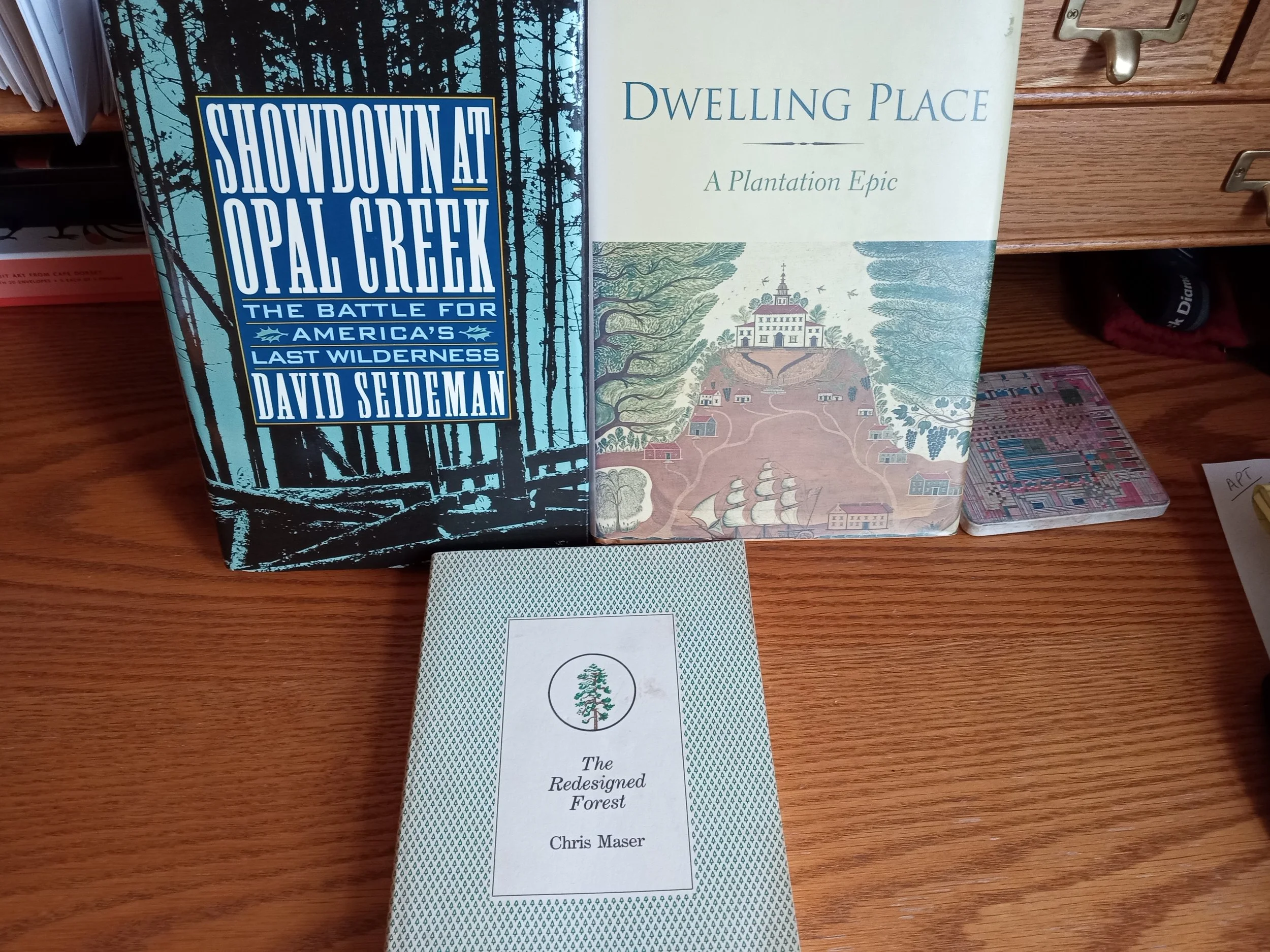
Showdown at Opal Creek by David Seideman is another book that has been waiting for me all of these years. Published in 1993, this book describes the effort, and pushback, to establish the Opal Creek Wilderness in Willamette National Forest in Oregon. In the genre of narrative non-fiction, Showdown at Opal Creek reads like a novel with vivid characters, poignant stories, and a world and way of life in tremendous flux. In the end, the Wilderness was established by an act of Congress in 1996. Given this all took place decades ago, I decided to look up on the internet what had become of the main character who worked to establish Opal Creek, George Atiyeh. In the most Shakespearean of tragedies, he died at his home during the Beechie Creek Fire of 2020, which burned large swaths of the Opal Creek Wilderness and Recreation Area.
The third book, on rather a different topic, is Dwelling Place by Erskine Clarke (2005). I bought this more recently, within the last ten years, but had not read much of it until recently. It is a hefty book at 601 pages and encompasses the years from 1805 to 1869 among the lives of enslaved people and owners at the same plantation (more correctly, work camp) on the Georgia coast. I confess to having felt a bit intimidated by this book until I actually started reading it. Clarke’s narrative is also quite readable with a wealth of information I’m currently seeking as I work on my second novel also set during the time of the American Civil War.

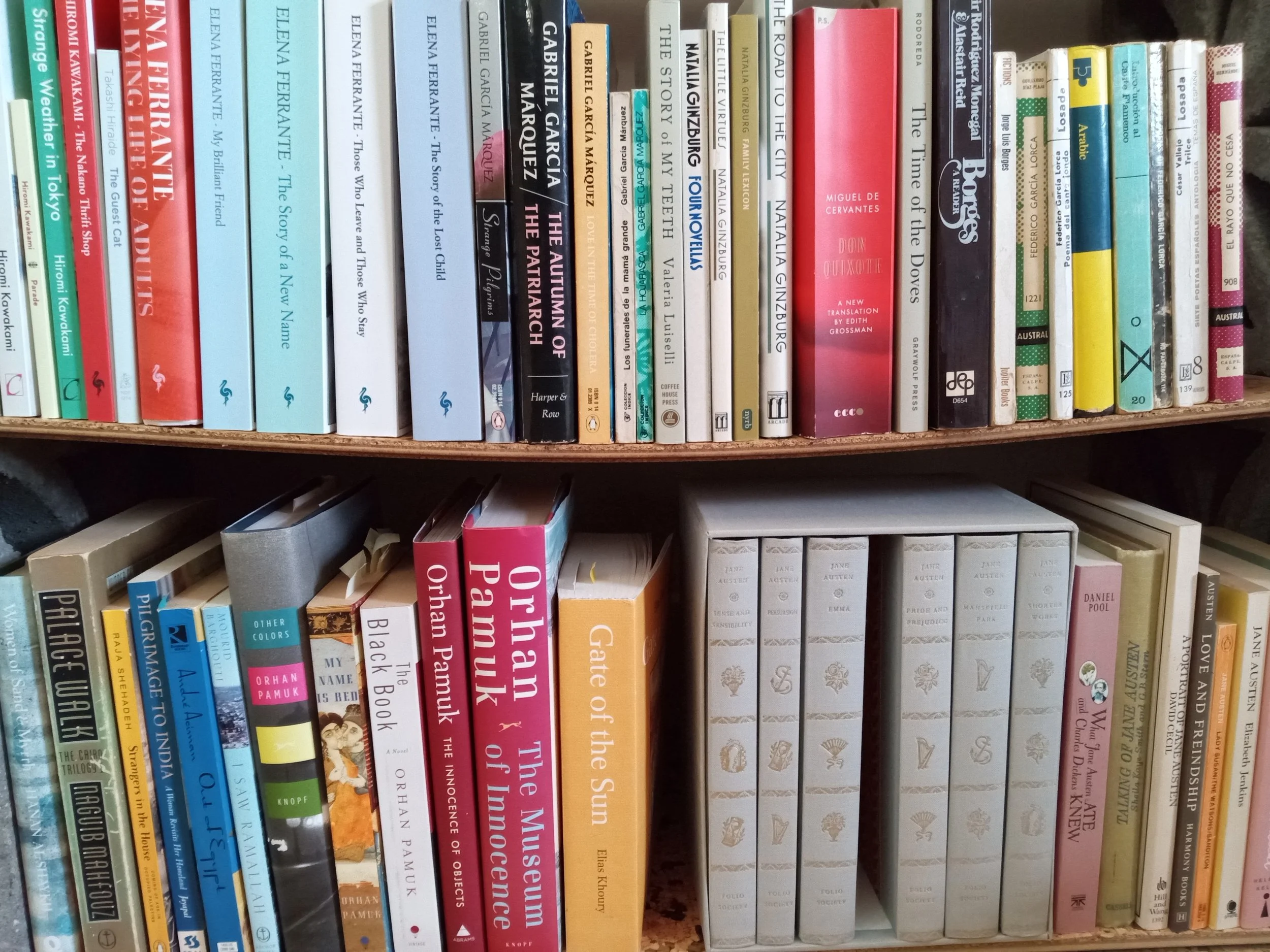
How wonderful it has been to have these books so available when I’ve needed them. And we have 2,200 just like them throughout the house (more actually since a recent inventory I made didn’t include my wife’s office, which I’d guess contains at least 1,500 more). Both of us love having books around, new ones, old ones, those given to us by special people in our lives, those we bought from the author and had inscribed. We have a children’s book section filled with the Great Brain series by John D. Fitzgerald, which I loved as a child, as well as Louisa May Alcott books that Barbara received from her mother, which previously had been her mother’s when she was a child. There’s the substantial collection of Virginia Woolf’s books, the Britannica Encyclopedia set (!), many books by Stieg Larsson and other writers in Norwegian and Danish (Barbara reads those), and our substantial natural history library. I have also started rereading Northanger Abbey since Jane Austen’s works seem to be making an appearance in my new novel.
When I was a child I loved reading certain books over and over. I think, apart from enjoying them, I liked the constancy the stories, once I knew them, provided. These included the Great Brain books, some of the Hardy Boys (especially one called The Secret Agent on Flight 101) by Franklin Dixon (really Carolyn Keene!), Where the Red Fern Grows and Summer of the Monkeys by Wilson Rawls, the Born Free series by Joy Adamson, and an adventure novel I so wish I could find again called Death at Their Heels (sadly, I don’t remember the author’s name but I know it took place in the Adirondack Mountains). Now, being much older and feeling like time is a finite commodity, I don’t reread books very often, but sometimes I do. In recent years, they’ve been a funny mixture: Gathering Moss by Robin Wall Kimmerer, Fried Green Tomatoes at the Whistle Stop Café by Fannie Flag, Intuition by Allegra Goodman, Pride and Prejudice by Jane Austen, and The Black Flower by Howard Bahr.
There are many books in our library here that I’ve wanted to read. Virginia Woolf falls into this category. I’ve tried, but I just haven’t been able to manage the stream of consciousness writing that many of her novels assume. Barbara recommends starting with her letters and essays, including A Room of Own’s Own, which I have listened to. Someday I will be a person who has read Virginia Woolf and Marcel Proust and all the works of Shakespeare (I’ve got Isaac Asimov’s Guide to Shakespeare on my bookshelf ready to go; in fact, I read selectively from it each time we’re about to see a new play, fantastically helpful!). Until then, however, the books will be patiently waiting and hopeful of being opened.